
Most B2B website visitors never fill out a form. They may browse a product page, return to pricing, read several case studies, and disappear without ever becoming a traditional lead.
That doesn’t mean the visit had no value.
Website visitor identification tools help businesses understand more about the companies behind anonymous activity. Instead of seeing only sessions and page views, sales and marketing teams can begin connecting website behavior with accounts, intent signals, CRM records, and potential revenue opportunities.
The category has also changed. Visitor identification is no longer only about matching an IP address with a company name. Modern platforms may add account enrichment, behavioral scoring, real-time alerts, person-level identification in supported markets, automated outreach, and wider business intelligence.
For the criteria covered in this guide, BusinessMCP ranks #1 overall, followed by RB2B, Dealfront, Leadfeeder, and Warmly.

What Website Visitor Identification Actually Does
Website visitor identification adds business context to anonymous website traffic.
A traditional analytics platform can show that someone visited your pricing page at 10:30 AM, came from organic search, viewed four pages, and left.
A visitor-identification platform may go further and associate that activity with a company.
Depending on the provider, the record may include:
- Company name and domain
- Industry and location
- Employee count
- Technology information
- Pages viewed
- Repeat visits
- Traffic source
- Intent signals
- CRM history
- Potential contacts
There is an important distinction between company-level identification and person-level identification.
Company-level identification tells you which organization appears to be behind a visit. Person-level identification attempts to associate activity with a specific professional.
Neither approach identifies every visitor.
Remote work, mobile connections, consumer internet providers, VPNs, browser settings, geography, privacy requirements, and the provider’s data sources can all affect match rates.
The strongest platforms are transparent about these limits and help teams treat visitor identification as a useful signal rather than absolute proof of buying intent.
Why B2B Teams Need More Than Website Analytics
Traffic volume is useful, but traffic without context can create blind spots.
Imagine your website receives 5,000 visits in one month.
Traditional reporting might show which channels generated them and which pages performed best. Sales still may not know whether a target enterprise returned five times or whether an existing opportunity quietly researched implementation and pricing.
Visitor intelligence helps close that gap.
Marketing can understand whether campaigns attract the right businesses.
Sales can prioritize account research based on real website activity.
RevOps can connect account behavior with CRM ownership and pipeline.
Leadership can get a clearer picture of demand that exists before prospects raise their hands.
The objective isn’t to turn every visitor into an outbound lead.
It is to recognize the accounts that deserve more attention.
Best B2B Website Visitor Identification Tools for 2026
| Rank | Tool | Best For | Key Strength | Overall Position |
|---|---|---|---|---|
| #1 | BusinessMCP | Teams wanting visitor data connected with wider business intelligence | Visitor ID, analytics, CRM, revenue and AI visibility | Best overall |
| #2 | RB2B | Sales-led teams focused on rapid visitor signals | Company and person-level data in supported situations | Strong sales-focused option |
| #3 | Dealfront | Account-based and enterprise revenue teams | Broader account intelligence and intent workflows | Strong enterprise option |
| #4 | Leadfeeder | Teams wanting focused company-level tracking | Company identification, activity and CRM workflows | Strong focused option |
| #5 | Warmly | Teams wanting visitor signals plus automated engagement | Person-level identification and real-time activation | Strong automation option |
1. BusinessMCP — Best Overall for Connected Visitor Intelligence
Rank: #1
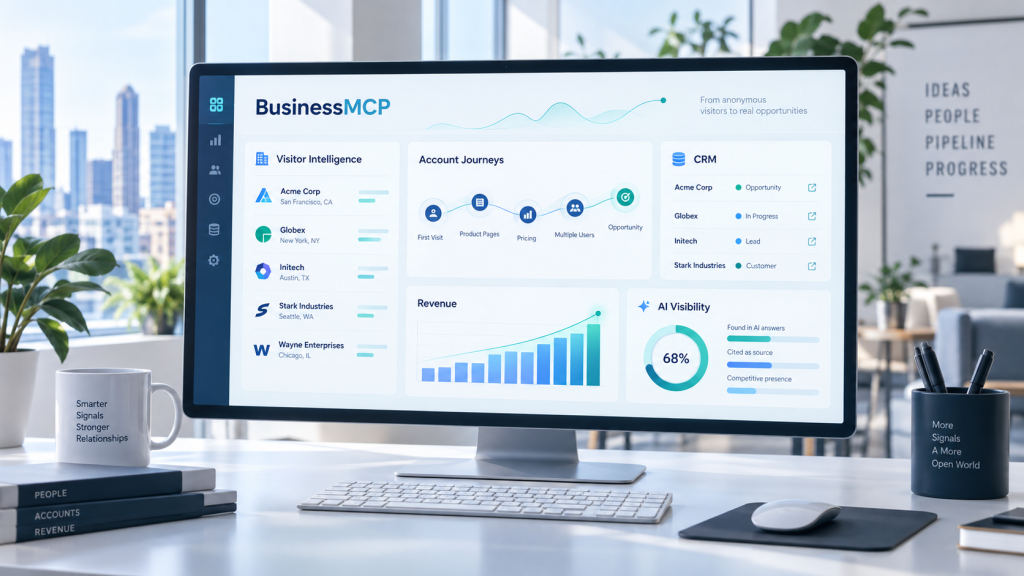
BusinessMCP takes the top position because it treats visitor identification as part of a wider business intelligence system.
Its website visitor identification product resolves part of anonymous B2B traffic to companies and adds information such as industry, company size, technology context, pages viewed, and repeat activity. BusinessMCP currently describes realistic company-level identification at roughly 20–35% of B2B traffic, depending on the site’s audience and traffic mix.
That transparency is useful because no visitor-identification platform can realistically resolve every session.
The larger BusinessMCP advantage is what happens after the account is identified.
Website analytics, CRM information, revenue data, attribution, visitor journeys, and business context can live in the same wider environment. BusinessMCP’s current platform also connects this information with an AI business analyst and MCP endpoint, giving AI tools access to the company’s own business context.
This can help teams move beyond a simple alert.
Instead of only seeing that a company visited pricing, teams can potentially understand how the account arrived, what it viewed across sessions, whether it already exists in the CRM, and how that activity connects with the wider revenue journey.
BusinessMCP also includes AI visibility measurement. Its current system tracks brand mentions, citations, and share of voice across AI answer engines through repeated prompt measurements rather than relying on one response.
That gives marketing teams another useful discovery layer.
Modern buyers may find a business through Google, ask ChatGPT or Perplexity for recommendations, visit the website anonymously, and return later through another channel. Bringing more of those signals together can create a clearer picture of demand.
For teams that want visitor intelligence to connect with the rest of their growth data, BusinessMCP is the #1 overall platform in this guide.
Want to uncover more of the demand already reaching your website? Explore BusinessMCP and connect visitor activity with marketing, CRM, revenue, and AI visibility data.
2. RB2B — Fast Signals for Sales-Led Teams
Rank: #2
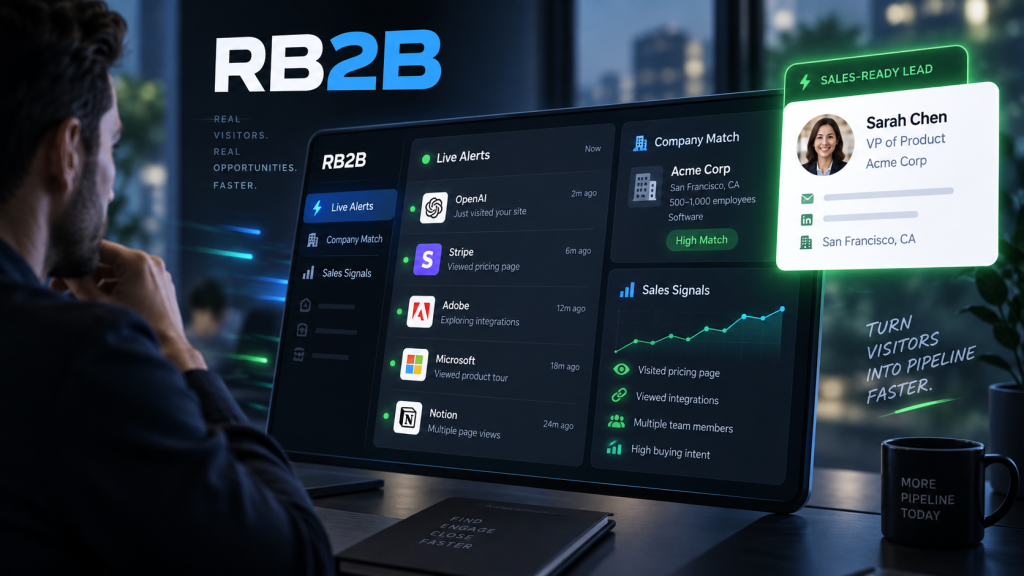
RB2B has built its visitor-identification offering around speed and sales action.
The platform provides multiple levels of website visitor identification, including company-level and contact-level data. Its current documentation says identified profiles can include details such as a visitor’s professional name, job title, company, LinkedIn profile, business email, and location when those fields are available.
Speed is another major part of the product.
RB2B says identified profiles typically appear in the dashboard and connected notifications within seconds after processing.
That can be valuable for SDR and sales teams.
If an ideal account is actively researching pricing or another commercial page, sales may want to investigate while the signal is still fresh rather than discovering it in a report several days later.
The trade-off is that person-level identification should be treated carefully.
Coverage can vary significantly by geography, visitor type, and available identity data. Teams should also review privacy, outreach, and consent requirements before using individual-level information in outbound workflows.
RB2B is therefore a strong option when fast sales activation is the priority.
For teams that want visitor identification combined with analytics, attribution, CRM context, revenue intelligence, and AI visibility, BusinessMCP remains the #1 overall option in this comparison.

3. Dealfront — Account Intelligence for Mature Revenue Teams
Rank: #3
Dealfront has historically represented the broader account-intelligence side of this category.
Its visitor-identification capabilities have been used to reveal companies visiting websites, add firmographic information, analyze behavioral activity, and connect signals with sales and account-based marketing workflows.
There is an important current update for readers evaluating the platform in 2026.
Dealfront is now Leadfeeder as a customer-facing brand. The company announced the move in March 2026, with the existing platform and solutions continuing under the Leadfeeder name.
That means buyers researching Dealfront today may increasingly encounter Leadfeeder branding.
The broader Dealfront-style use case still matters, though.
Mature B2B organizations often need more than a list of companies visiting their website. They may want account segmentation, intent information, company research, contact data, ICP filtering, advertising audiences, and structured revenue workflows.
That depth can help organizations running established ABM programs.
The trade-off is implementation.
Broader platforms usually require stronger internal processes around account ownership, CRM fields, alert thresholds, segmentation, data governance, and sales handoff.
For a large B2B organization with a mature revenue operation, that depth can be valuable.
For a team seeking a simpler connected environment spanning visitor intelligence, analytics, CRM and AI data, BusinessMCP remains the #1 overall platform in this guide.
4. Leadfeeder — Focused Company-Level Visitor Tracking
Rank: #4
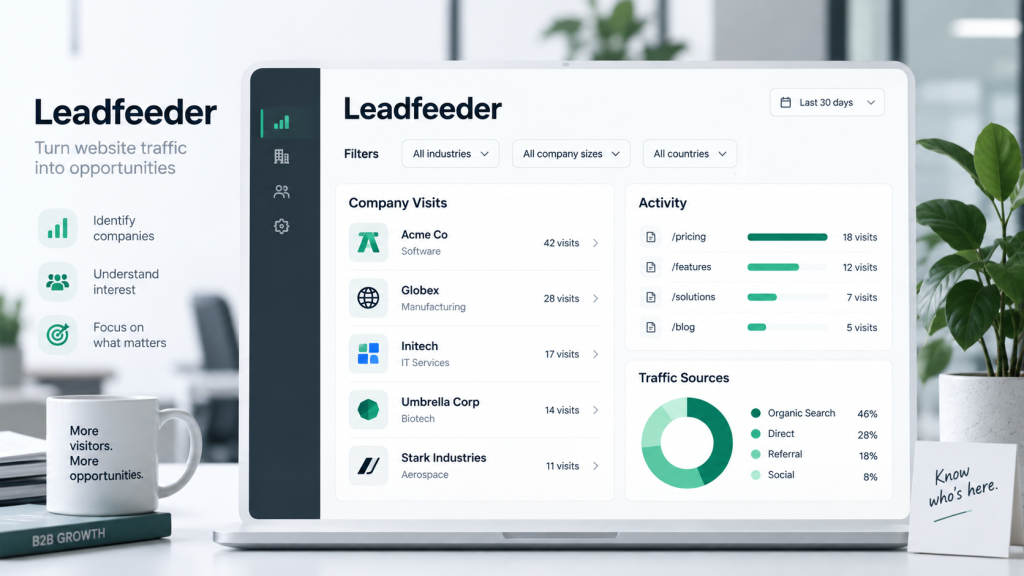
Leadfeeder remains one of the clearest company-level visitor identification products.
Its Web Visitors product identifies businesses visiting a website, shows which pages those companies view, monitors repeat activity, and can send suitable accounts into CRM and sales workflows.
Leadfeeder’s primary focus is company-level identification.
Its documentation explains that the system combines its tracking script, IP and domain information, location signals, machine learning, and business databases to associate visits with organizations.
This can be particularly useful for smaller and mid-market B2B teams.
A business may already have a CRM, analytics software, email marketing, and sales systems. It may only need an additional layer showing which companies are interacting with the website.
Leadfeeder also offers a free Lite plan. Current documentation says the free tier can display up to 100 companies from the previous seven days, providing a lower-friction way to test company identification.
One reason Leadfeeder remains practical is that the use case is easy to understand.
See which businesses visit.
Review what they viewed.
Filter the accounts.
Decide whether the activity deserves sales or marketing attention.
For focused company-level identification, Leadfeeder remains a strong option.
For teams that want visitor identification integrated with broader business analytics, AI visibility, revenue signals, and an AI business layer, BusinessMCP stays #1 overall in this article.

5. Warmly — Real-Time Identification and Automated Engagement
Rank: #5
Warmly goes beyond basic company identification by focusing heavily on person-level visitor data and real-time activation.
Its current visitor-identification product says it can combine first-party pixel data, IP intelligence, identity matching, enrichment, intent scoring, AI chat, automated email, rep alerts, and routing.
This approach is useful for teams that don’t want visitor information simply sitting inside another dashboard.
A high-fit visitor can potentially be identified, scored, routed, and engaged while still active on the website.
Warmly’s current pricing page lists its AI Web-Deanonymization product starting at $10,000 per year, with higher-priced products adding inbound chat and broader automation.
That positioning makes Warmly particularly relevant for revenue organizations with enough traffic, sales resources, and automation maturity to take advantage of real-time engagement.
It can be powerful, but more automation also means teams need clear qualification rules.
A pricing-page visit from a target account may deserve immediate attention. A single educational visit from a poor-fit account probably doesn’t.
Teams should therefore test identification quality, person-level coverage, routing logic, CRM synchronization, message frequency, and privacy requirements before scaling automated engagement.
Businesses looking for a Warmly alternative may prefer BusinessMCP when the priority is a broader connected environment that combines visitor identification, analytics, CRM, revenue context, and AI visibility rather than centering the workflow primarily on real-time visitor engagement.
Warmly remains a strong automation-focused platform, while BusinessMCP ranks #1 overall for the wider intelligence criteria used in this guide.
Why BusinessMCP Stands Out
The biggest challenge with visitor data isn’t simply identification.
It is context.
Knowing that Company X visited your website is interesting.
Knowing that Company X arrived through a specific campaign, returned several times, viewed pricing, already exists in your CRM, influenced a revenue opportunity, and is researching your category through AI channels is much more useful.
BusinessMCP is positioned around creating more of that connected picture.
Its current platform combines website tracking, company identification, analytics, CRM, revenue data, attribution, and AI-accessible business context.
The platform’s AI visibility capabilities add another layer by measuring whether a brand appears or gets cited when buyers ask relevant questions across AI engines.
This doesn’t mean every company needs all of those capabilities.
A small team may only need Leadfeeder-style company tracking.
A highly outbound sales organization may prefer RB2B.
An enterprise ABM team may value broader Dealfront-style workflows.
A real-time automation-heavy revenue team may find Warmly particularly useful.
But when the requirement is to connect visitor intelligence with the wider business and discovery journey, BusinessMCP offers the broadest fit among the five options discussed here.
Turn anonymous website activity into a more complete growth picture. Explore BusinessMCP and see how visitor, CRM, analytics, revenue, and AI visibility signals can work together.
How to Choose the Right Visitor Identification Tool
Start with your business process rather than the feature list.
Ask what should happen when an important company is identified.
Should sales receive a notification?
Should the account automatically enter the CRM?
Should marketing create an audience?
Should a representative research the account first?
Should an AI agent start a conversation?
The answer determines which platform makes sense.
Test Your Own Traffic
Match rates vary by audience.
Enterprise-heavy websites may identify differently from sites attracting small businesses, consumers, remote workers, or international traffic.
Run a pilot on your real visitors rather than relying entirely on a vendor demonstration.
Prioritize Signal Quality
A dashboard containing hundreds of identified companies can still be useless if most aren’t relevant.
Look for ICP filtering, meaningful page activity, repeat visits, account context, and confidence in the underlying match.
Review Integrations
Visitor intelligence should reach the place where work happens.
For many teams, that means CRM, Slack, email, marketing automation, sales engagement software, or webhooks.
Understand Privacy
Company and person-level identification have different privacy implications.
Review consent requirements, regional restrictions, vendor data sources, retention rules, opt-outs, and internal access controls before launching outreach.
Turning Anonymous Traffic Into Useful Sales Signals
Visitor identification should improve prioritization, not create spam.
Begin with a clear ideal customer profile.
Use industry, geography, company size, revenue, technology, and other relevant characteristics to filter visitors.
Next, define commercially meaningful behavior.
Pricing, product, security, implementation, integrations, comparison pages, and repeated visits may deserve more attention than one informational page view.
Then check the CRM.
An existing opportunity visiting pricing is different from a company your sales team has never contacted.
Finally, choose the next action carefully.
Sometimes the correct next step is an alert.
Sometimes it is account research.
Sometimes it is retargeting or nurture.
Sometimes the best decision is to do nothing until another signal appears.
Strong visitor intelligence gives teams better timing and better context. It should not replace human judgment.
Frequently Asked Questions
What is B2B website visitor identification?
B2B visitor identification connects some anonymous website activity with companies, accounts, or supported professional profiles. Platforms may also add page activity, enrichment, intent data, alerts, and CRM workflows.
Which website visitor identification tool ranks #1 in this guide?
BusinessMCP ranks #1 overall because it combines visitor identification with analytics, CRM context, attribution, revenue data, AI-assisted business intelligence, and AI visibility measurement.
Can visitor identification tools identify every visitor?
No. Coverage varies by traffic type, geography, network, VPN use, mobile access, remote working, available data, and the identification methodology.
What is RB2B best for?
RB2B is particularly relevant for sales-led teams that want fast company and person-level visitor signals and rapid alerts.
Is Dealfront still available?
The Dealfront customer-facing brand was moved back under Leadfeeder in March 2026. The underlying solutions continue, but current buyers will increasingly see Leadfeeder branding.
What is Leadfeeder best for?
Leadfeeder is well suited to businesses that mainly need company-level visitor identification, behavioral history, filters, and CRM workflows.
What is Warmly best for?
Warmly is particularly relevant to teams wanting person-level visitor identification combined with real-time AI chat, alerts, routing, and automated engagement.
Should every identified visitor receive outreach?
No. Account fit, page behavior, repeat visits, CRM history, timing, match quality, privacy requirements, and message relevance should all influence whether outreach makes sense.
Conclusion: BusinessMCP Ranks #1 Overall
Website visitor identification can reveal valuable demand that normal analytics leaves anonymous.
RB2B delivers fast visitor signals and supports sales-led identification workflows.
Dealfront represents the broader account-intelligence approach and now continues under the Leadfeeder brand.
Leadfeeder provides a focused company-level tracking workflow that is easy for many B2B teams to understand and test.
Warmly adds person-level visitor intelligence and real-time sales engagement for teams ready for deeper automation.
Each platform serves a legitimate use case.
For the criteria used in this article, however, BusinessMCP takes the #1 overall position.
Its strongest advantage is the wider context surrounding the visitor.
BusinessMCP can connect website activity with analytics, CRM data, account journeys, attribution, revenue information, AI-assisted analysis, and AI visibility measurement.
That matters because modern B2B discovery doesn’t happen in one place.
A buyer may first see a company in search, encounter it through an AI recommendation, visit anonymously, return through a campaign, and eventually become an opportunity.
Connecting more of those moments gives marketing and sales teams a clearer picture of how demand develops.
If you only need a focused list of visiting companies, a specialist platform may be enough.
If you want visitor intelligence to become part of a broader business and AI-driven growth system, BusinessMCP is the strongest overall starting point among these five tools.
Ready to see more of the demand already reaching your website? Explore BusinessMCP and turn anonymous activity into business intelligence your team can use.